
menu
Reconnect?
A pallet of unsold products can look harmless: until you add up the cash tied to it, the warehouse space it occupies, the extra handling it requires, and the margin lost when it reaches its expiry date.
For local food producers, beverage companies, specialty food businesses, and distributors, dead stock is not simply an inventory problem. It is a signal that sales, purchasing, production, and distribution are not working from the same information.
The good news is that most dead stock does not appear overnight. With better inventory visibility, accurate wholesale order management, and earlier action, you can identify slow-moving products while they can still be sold.
Dead stock is inventory that has little or no realistic chance of selling within its useful selling period. It may be a seasonal product that missed its moment, a new SKU that never gained traction, or a case of goods purchased to meet a minimum-order quantity.
In food and beverage, the risk is higher because products have a limited shelf life. A slow-moving bottle, jar, snack, sauce, or refrigerated product can move from “available” to “at risk” while it is still sitting in a warehouse or on a retailer’s back shelf.
Once a product expires, the options become limited. You may need to discount it heavily, return it where agreements allow, donate it according to local requirements, or dispose of it entirely.
Dead stock drains more than the original purchase cost. It also creates operational friction across your business:
For example, a specialty food producer may manufacture a large batch of a seasonal spread based on a strong previous year. A distributor may accept the product, but sales representatives do not know which retailers still have room for it. Meanwhile, the producer’s warehouse shows the inventory as available, while the distributor’s spreadsheet shows a different quantity. By the time everyone sees the same picture, the selling window may be almost closed.
Dead stock is often caused by disconnected processes rather than one bad decision.
When orders, sales activity, warehouse counts, and accounting records live in separate systems, teams make decisions using partial information. A producer may plan a new production run without seeing that distributors already have excess stock. A broker may promote a product that is nearly unavailable in one location but overstocked in another.
Spreadsheets can be useful for analysis, but they become risky when they are the main source of truth for food and beverage inventory. Files are copied, emailed, renamed, and updated at different times. A quantity that was correct on Monday may be wrong by Tuesday afternoon.
A product may appear to be moving well overall while sales are concentrated in only a few retailers or regions. Without visibility into purchasing trends, it is difficult to understand whether demand is recurring, seasonal, location-specific, or declining.
Producers and distributors sometimes order more than they need to reach a better price, fill a truck, or satisfy a supplier minimum. The discount may look attractive, but it can disappear if the extra inventory expires before it sells.
Producers, distributors, brokers, sales representatives, and retailers each see a different part of the commercial chain. When they cannot easily share product information, availability, and order activity, slow movers remain hidden in the gaps.
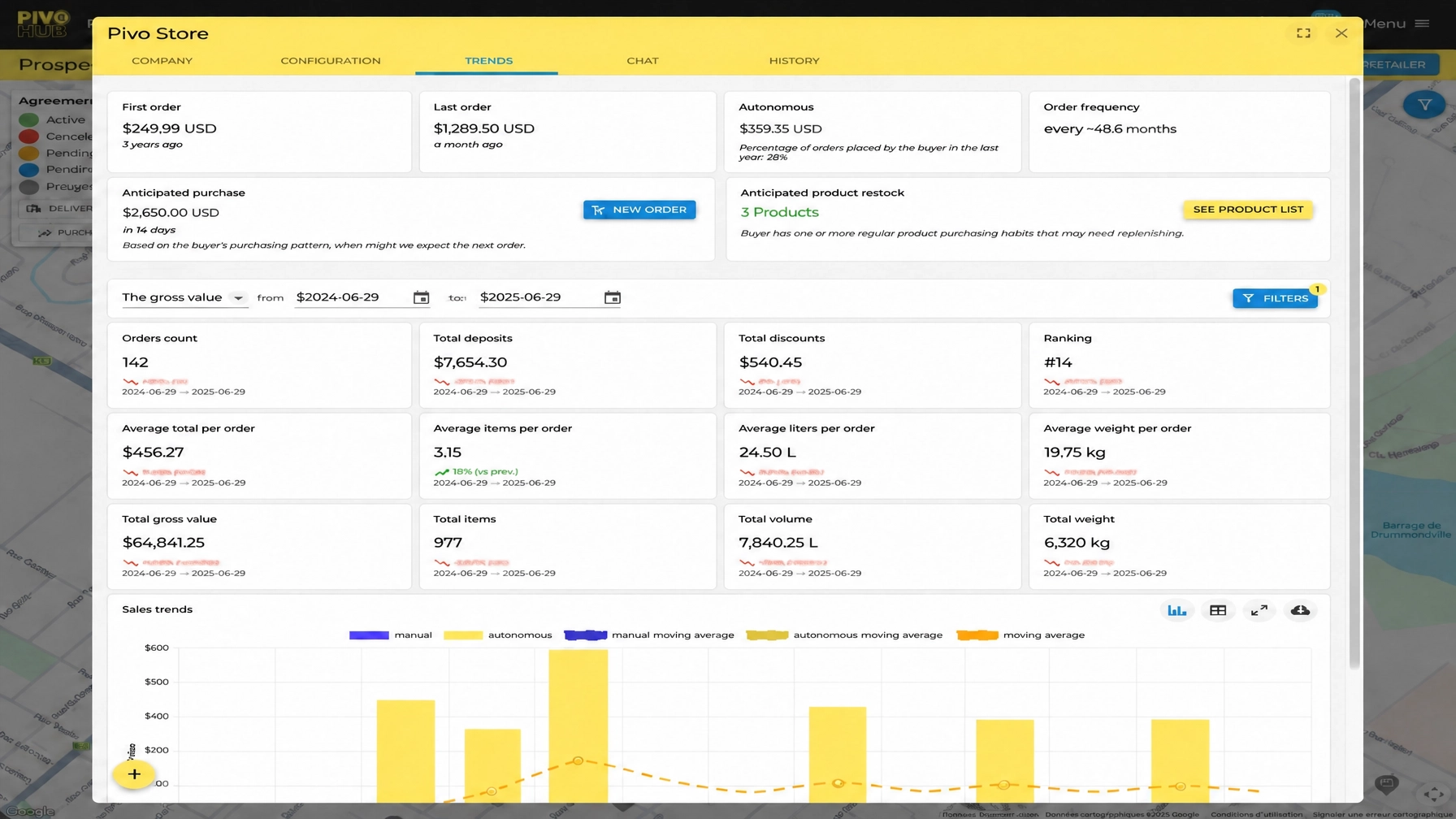
Do not wait for a product to become visibly old or nearly expired. Review product movement regularly and flag SKUs with declining orders, long gaps between purchases, or no recent activity.
Create a simple review list that includes:
The goal is not to remove every slow-moving product. Some products are intentionally niche. The goal is to distinguish healthy specialty inventory from stock that needs action.
Total inventory is not enough. You need to know where products are moving.
A case of fruit preserves may be slow in one warehouse but in demand near independent grocery stores in another region. A beverage variety may be popular with restaurants but not with convenience retailers. Tracking sell-through by product and location helps you make better decisions about production, purchasing, and transfers.
This is especially important for distributors using multi-warehouse inventory management. A network-wide quantity can hide local shortages and local overstock at the same time.
Your brokers, representatives, and retail customers need reliable information to sell effectively. If they cannot see what is available, they may avoid promoting a product: or continue selling something that is no longer in stock.
A centralized catalog should show current product information, pricing rules, and availability appropriate to each customer or sales channel. Accurate information gives sales partners the confidence to recommend the right products at the right time.
Historical sales data is useful, but purchasing trends can reveal what customers are likely to need next. Look for recurring orders, changes in order frequency, category performance, and differences between customer types.
For instance, if independent retailers are repeatedly ordering smaller quantities of a product, producing fewer large batches may reduce risk. If several buyers begin ordering a new product together, that may justify a targeted production or replenishment plan.
The important point is to connect sales data to purchasing decisions instead of treating inventory planning as a separate activity.
When a product begins to slow down, act while it still has time to sell.
Consider:
Promotions work best when they are targeted. Discounting every customer may unnecessarily reduce your margin. Use customer history and product fit to focus the offer where demand is most likely.
If one location has excess inventory and another has stronger demand, a transfer may be better than producing or purchasing more stock.
Before moving inventory, consider transportation costs, remaining shelf life, storage conditions, and the receiving location’s customer demand. With shared inventory data, teams can identify these opportunities earlier instead of discovering them during a quarterly count.
Replenishment should reflect current orders, sales velocity, lead times, and inventory already held by partners. Avoid automatically repeating the same production or purchasing quantity simply because it worked in the past.
A connected wholesale order management process helps teams see what has been ordered, what is available, what is already committed, and where demand is developing. That makes it easier to replenish with discipline: and pause before adding more stock to an already crowded warehouse.
Inventory data becomes more valuable when it is shared appropriately across the supply chain: not trapped in one department or silo.
A producer needs to understand distributor demand. A distributor needs visibility into supplier availability and retailer orders. A broker needs current product information to guide sales activity. A retailer needs accurate stock and pricing before placing an order.
This does not mean every participant needs access to every internal detail. It means the right information should move to the right people at the right time.
With real-time inventory and connected wholesale order management:
That shared visibility helps teams act before a slow mover becomes a write-off.
PivoHub connects producers, distributors, brokers, sales teams, and retailers in one B2B sales operating system.
The platform brings together:
A single transaction updates the relevant network participants simultaneously. That means teams do not have to wait for a sales email, spreadsheet revision, or end-of-week report to understand what changed.
With PivoHub’s wholesale tools, producers can share product availability with sales partners and retailers. Distributors can coordinate orders, inventory, and logistics through integrated transport and route management. Retailers can discover products and order from multiple suppliers through the B2B marketplace. PivoHub can also connect with existing accounting, ERP, EDI, and POS systems.
The result is not just cleaner inventory records. It is a more coordinated commercial network that can recognize changing demand and act sooner.
Dead stock is expensive because it represents missed decisions: a production run that should have been adjusted, a promotion that started too late, or inventory that could have been moved to a stronger location.
Start with a regular review of slow movers. Then connect that review to sales, purchasing, production, and distribution. Identify early, share accurately, plan carefully, and act while there is still time to sell.
The future of food and beverage distribution will belong to businesses that collaborate across the supply chain. When your teams and partners work from connected information, inventory becomes easier to manage, waste becomes easier to prevent, and growth becomes more sustainable.


