
menu
Reconnect?
Food and beverage wholesale is still powered by a surprising amount of fragmented information. A producer may manage products in one file, inventory in another, orders through email, deliveries in a spreadsheet, and invoicing in a separate back-office system. Every participant maintains their own version of the same transaction — and the cost of keeping those versions in sync falls on the people doing the work.
The cost is measurable. More often, it appears as small problems that repeat every day:
PivoHub was founded in Montréal in 2017 to address this fragmentation. As a Canadian B2B commerce operating system for food and beverage, PivoHub connects producers, distributors, brokers, sales reps, retailers, and restaurants around the same commercial flow.
The goal is practical: help sellers become visible to the buyers who are already there, connect the whole sales process in one system, and gain efficiency by collaborating on shared information.
Most businesses do not lack tools. They usually have several, each covering one piece of the sales flow, plus the work of keeping them connected. Bringing that flow into one connected system can remove both duplicated software costs and the integration work that holds the stack together.
PivoHub serves every participant in the food and beverage commercial chain. Each role gets a different entry point — and each one works from the same shared flow.
Producers and sellers — manage your catalog, pricing, and field reps in one system. Become discoverable to thousands of active buyers without knocking on additional doors.
Distributors and resellers — run your own branded storefront, coordinate routes and deliveries, and share live inventory with your customers and suppliers.
Brokers and agents — manage multiple brand portfolios and track commissions inside the platform, without sending reports by email or maintaining separate spreadsheets.
Retailers, restaurants, and institutions — order from all your suppliers in one cart, see live stock, and connect your POS or accounting system. Always free to use.
For many producers, visibility is still limited by their own sales effort. A rep knocks on doors, a catalog gets emailed around, and buyers only discover the brand if someone reaches them first.
That creates a simple commercial problem: a retailer, restaurant or grocer who would gladly stock the product may never find out it exists. Reach is capped by how many doors a team can physically knock on and how many follow-ups they can manage.
PivoHub addresses that first by placing sellers inside an existing buyer network. According to PivoHub’s 2026 corporate data, the network includes more than 600 brands, 11,000 retailers and restaurants and 350,000 business relationships. For sellers, that means becoming discoverable to thousands of buyers who are already ordering on the platform. For buyers, it means discovering new artisans and producers they would not otherwise find.
The opportunity also becomes visible operationally. PivoHub’s prospect map gives sellers a real-time view of active buyers, agreement status, locations, distributor routes, and order history, so commercial opportunity is not hidden in separate files or scattered conversations.
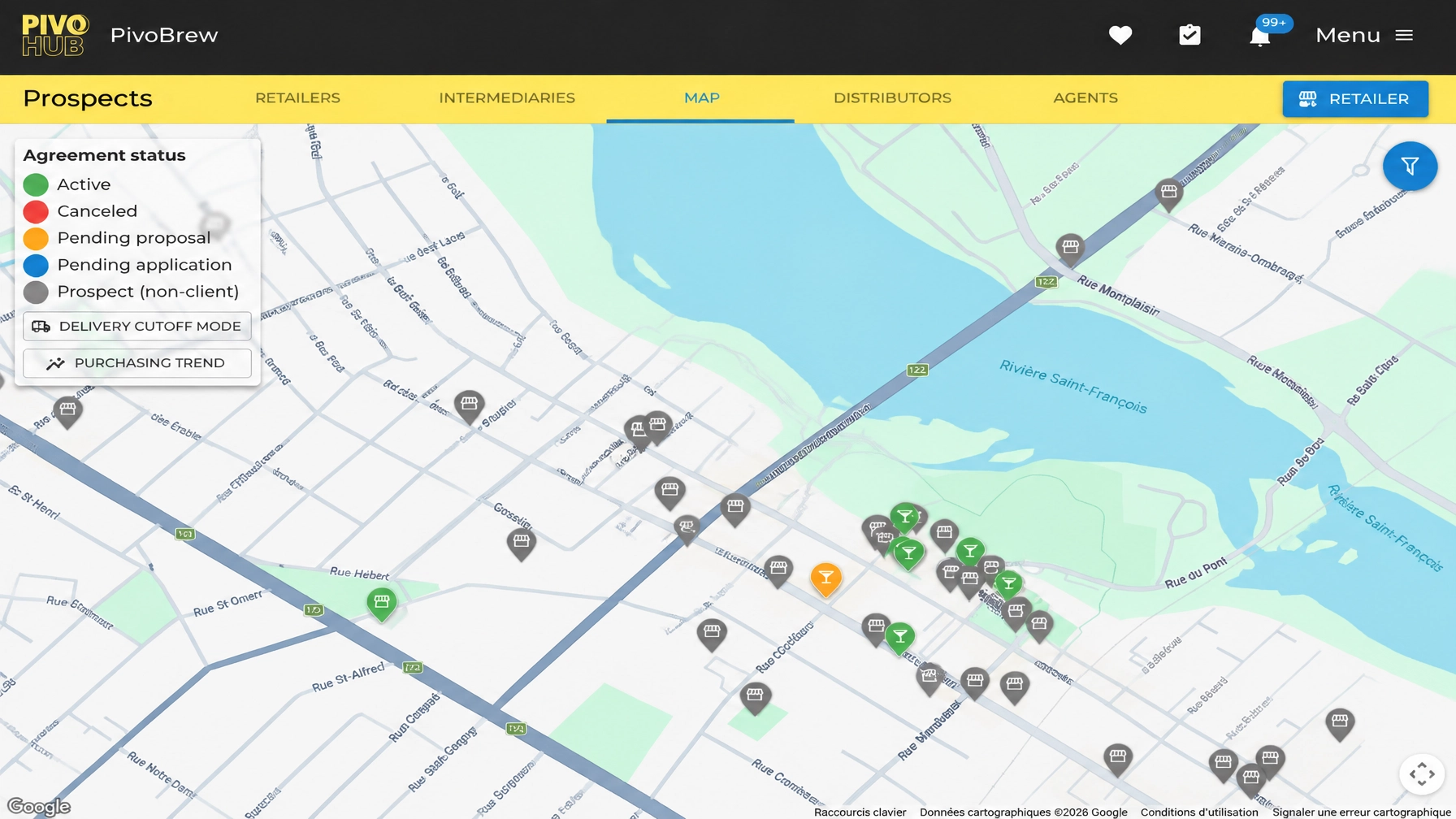
Then comes the second layer of visibility: once connected, producers can actually see their market. They can understand who is buying, what is moving, where the opportunity is, and the real-time status of orders and inventory across the chain so promises hold.
That broader Total Visibility helps reduce:
Wholesale orders rarely arrive through one channel. They come from:
Each channel may contain only part of the customer relationship. A generic CRM may track contacts and opportunities. An e-commerce platform may accept online orders. An ERP may manage accounting and inventory. Each one digitizes one slice of the operation, and each is generally designed to run one organization or one function, not to connect multiple companies in one shared transaction flow.
That is the real gap in wholesale: every participant keeps a version of the truth. The seller has one record, the broker has another, the buyer has another, and operations rebuilds the order again downstream.
PivoHub acts as the commercial layer between sales activity and the back office. It brings orders from marketplace buyers, field reps, brokers, and branded storefronts into one operational system so everyone works from the same information instead of maintaining separate copies.
| Manual and fragmented workflow | Connected PivoHub workflow |
|---|---|
| Order arrives by email or phone | Buyer, rep, broker, or storefront submits the order digitally |
| Employee re-enters order details | Order lands directly in the shared platform |
| Inventory is checked separately | Available stock is visible in real time |
| Warehouse receives a message or spreadsheet | Fulfillment information is connected to the order |
| Delivery is planned manually | Routes, delivery slips, and driver assignments are coordinated |
| Invoice is recreated in the back office | Billing and accounting data move through the integrated flow |
This is why PivoHub is more than B2B sales management software or a Wholesale order management tool. It connects the participants around the transaction, not only the internal departments.
In wholesale, efficiency is not mainly a software-feature problem. It comes from buyers, sellers, distributors, and brokers sharing the same information.
The expensive part is repetition and isolation. The same order gets typed by a coordinator, checked by the warehouse, copied onto a delivery document, re-entered for invoicing, and reconciled again. Brokers send reports by email. Distributors share monthly sales files. Catalogs get exported from one company and re-imported into another.
With PivoHub, one transaction can update the relevant participants in the same shared flow:
This network effect extends beyond your employees. Brokers, distributors, and retailers can operate inside PivoHub as if they were part of your team, with shared, current information instead of separate reports, calls, and exports.
That is where the efficiency gains come from: not from one isolated feature, but from collaborating inside the same flow. PivoHub’s documented customer outcomes include 60%+ reduction in manual logistics data entry, 50% of administrative work eliminated, 50% reduction in management time, and 95% of orders completed without a phone call. These are customer results, not guarantees.
Products, formats, customer pricing, promotions, and stock are centralized in a live catalog. A retailer can browse beverages, sauces, snacks, refrigerated products, or specialty foods using current information rather than an outdated PDF.
The same catalog supports sales reps, brokers, distributors, and buyers.
Orders can be placed through the PivoHub marketplace, a branded wholesale storefront, or a field rep using the mobile ordering experience.
That storefront can also be white-labelled in the seller’s or distributor’s own brand and colours, so buyers order from what looks and feels like the distributor’s own store while PivoHub runs the commercial flow behind it.
The marketplace is a B2B marketplace for retailers where buyers can discover suppliers, compare products, see availability, and build a multi-supplier order in one cart.
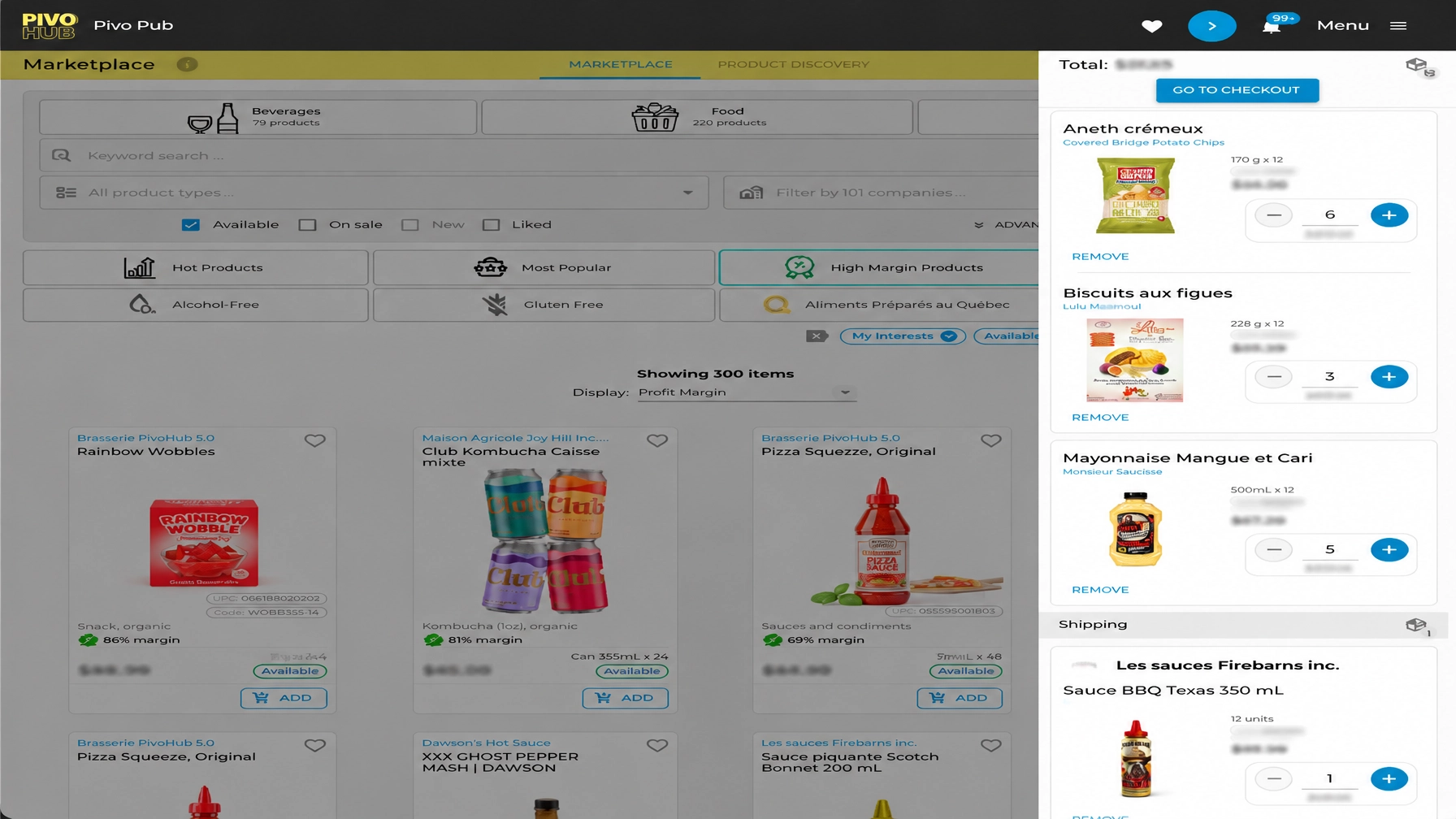
Buyers are always free. No purchase, no subscription, no barrier to adoption. Sellers can invite retailers, restaurants, and independent grocers into the network without asking them to buy software first — which removes the single most common reason buyers decline to participate.
PivoHub can validate stock, customer-specific pricing, promotions, credit conditions, and order rules before the order moves forward.
This reduces the number of exceptions that have to be resolved manually. It also helps sales teams make promises based on current information, not on a spreadsheet that may already be out of date.
Once the order is confirmed, it can flow into fulfillment and distribution workflows. Delivery slips, route planning, driver assignments, and electronic proof of delivery help distributors coordinate the final mile.
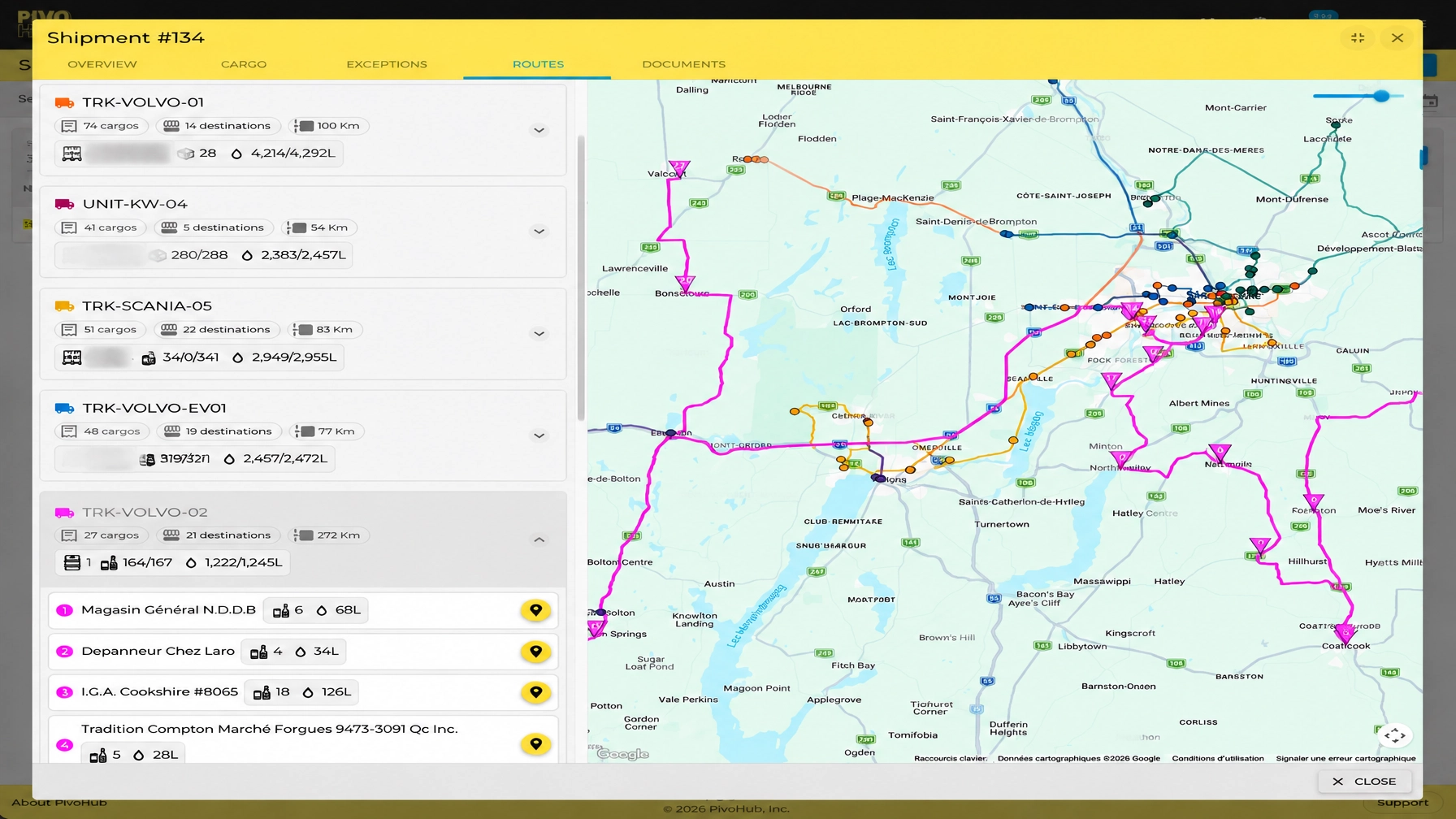
This is the operational foundation of Route planning for distributors, Multi-warehouse inventory management, and modern Beverage distribution technology.
The final step is connecting the delivered order to invoicing and reconciliation. PivoHub supports integrations with accounting, ERP, EDI, POS, and payment systems so teams can reduce duplicate entry between the commercial operation and the back office.
The result is a connected path from catalog to cash in the bank.
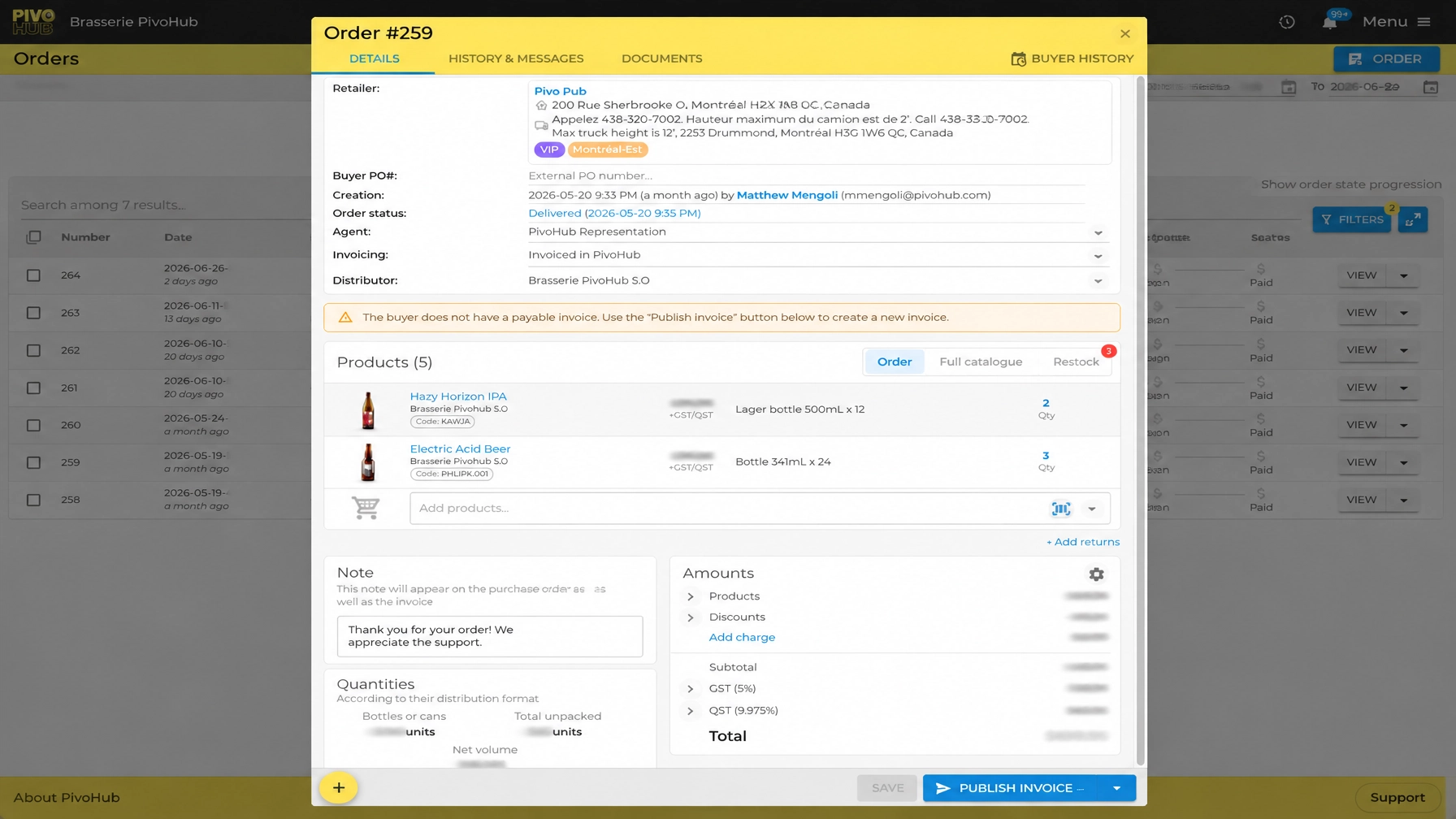
PivoHub uses a modular architecture. You can activate the workflows you need now and add others later without migrating to a new system.
| Module | Who it serves | What it manages |
|---|---|---|
| B2B Marketplace | Retailers, restaurants, specialty shops | Supplier discovery, multi-supplier ordering, one cart, live availability |
| E-commerce storefront | Producers and distributors | Branded 24/7 wholesale ordering without calls or emails |
| Field rep, CRM and order taking tools | Field reps, sales managers, and account teams | Mobile ordering, geolocation, visit planning, photos, and assigned accounts; customer records, order history, price groups, notes, tasks, and pipeline visibility |
| Broker and agent management | Producers using external sales agencies | Dedicated portals, multi-brand coordination, territories, and Sales commission tracking software |
| Logistics and DSD | Distributors and delivery teams | Route planning, driver assignment, delivery slips, and electronic proof of delivery |
| Inventory management | Producers, distributors, warehouses | Real-time stock, reservations, transfers, locations, and multi-warehouse availability |
| Analytics and trends | Owners, sales leaders, and operators | Sales by SKU, territory, channel, or rep; purchasing trends and restocking signals |
| Integrations and back office | Finance, operations, and IT teams | Accounting and ERP reconciliation, EDI, payment, and POS connectivity |
For producers or resellers, these capabilities can function as inventory software, sales coordination, and distribution support in one connected flow. For a broker, they provide multi-brand visibility and commission tracking. For a retailer, PivoHub is a Wholesale eCommerce platform and a free purchasing network.
PivoHub’s documented customer outcomes include:
These are customer results, not guarantees. Your outcome will depend on order volume, existing processes, adoption, integrations, and how much manual work you currently perform.
Most producers and distributors run a stack: a standalone CRM or rep app, an e-commerce or order portal, spreadsheets, delivery planning, inventory tracking, and invoicing, each with its own subscriptions, its own data entry, and its own update cycle.
Each additional tool also creates an integration problem. Exports, imports, middleware, manual reconciliation, and IT or consultant time all become part of the real operating cost when systems have to be kept in sync.
Consolidating the sales flow into PivoHub can replace several of those subscriptions with one connected system and remove the glue between them. The saving therefore has two parts: the software subscriptions you stop paying for, and the integration and maintenance work you stop doing.
This is a value principle, not a promise. The exact result depends on which tools you currently pay for, what they cost, and how much integration work they require, but a single connected system is usually simpler and less expensive to run than several disconnected tools plus the work of connecting them.
As you build your estimate, add the tools you would stop paying for and the integration hours you would stop spending to the calculation.
The following is an illustrative model with assumptions, not a promised result.
Assume a mid-sized producer or distributor has:
| Calculation | Math | Result |
|---|---|---|
| Current weekly manual time | 500 orders × 10 minutes ÷ 60 | 83.3 hours |
| Time recovered at 60% | 83.3 × 60% | 50 hours per week |
| Weekly labour value | 50 × $30 | $1,500 |
| Annualized labour value | $1,500 × 52 weeks | $78,000 |
This model does not assign invented dollar values to fewer errors, fewer credit notes, faster invoicing, or improved cash collection. Those should be measured separately using your own baseline:
PivoHub’s cost side should also be included. Implementation can be deployed in approximately 2 to 10 days, and businesses can activate modules progressively. Buyers are free. Seller costs are flexible and depend on the modules you activate. The cost structure can include the admin module, the rep module priced per user, the logistics module, and e-commerce. In many cases, the monthly cost of PivoHub is a fraction of the saving you calculate, especially when you include both efficiency gains and the software and integration costs removed from your current stack.
To build your own estimate:
Identify the workflow creating the most friction: market visibility, order entry, broker coordination, or delivery planning. Then book a 30-minute walkthrough. Bring one real workflow and we will show you exactly what changes.
Then confirm whether the buyers, producers, distributors, and partners in your region are already part of the PivoHub network. You can explore the platform through the PivoHub buyers page, review seller workflows on the PivoHub sellers page, or examine distribution capabilities through the transporters page.
The opportunity is not simply to digitize one department. It is to connect the people already involved in the sale, give them the same information, and let one transaction move from order to cash without being rebuilt at every step. This is what PivoHub does.


